Get A Free Quote
1300 007 782
Call Us On:
1300 007 782G10/RMS Accredited
Competitive Rates
ZERO Accidents or Injuries
25+ years combined experience
50+ years combined experience
Competitive Rates
G10/RMS Accredited
ISO Certified


In the construction and development industry, particularly across New South Wales, the path to a successful project is paved with paperwork. Before a shovel hits the ground or a crane swings into action, developers must navigate a labyrinth of regulatory requirements. Among the most confusing hurdles are the acronyms surrounding traffic safety: CTMP, TMP, TCP, and TGS.
For many Site Managers and Developers, these terms are often used interchangeably. However, in the eyes of local Councils, Transport for NSW (TfNSW), and SafeWork NSW, they are distinct documents with vastly different purposes. Confusing a Traffic Control Plan with a Construction Traffic Management Plan can lead to rejected Development Applications (DAs), stalled road occupancy permits, and significant project delays.
At Site Security and Traffic Control (SSTC), we believe that clarity is the first step in safety. We don't just supply the boots on the ground; we provide the strategic planning required to get your site approved. This guide breaks down the hierarchy of traffic planning documents, explaining what you need, when you need it, and why professional design is your best insurance against compliance failure.
To understand these documents, it helps to view them as a funnel, moving from the broad strategic vision down to the specific placement of a single traffic cone.
Understanding where your project sits in this hierarchy is critical for securing your Road Occupancy Licences (ROLs) and council permits.
The CTMP is a high-level strategic document. It is almost always required during the Development Application (DA) phase for medium to large projects.
The Purpose: The CTMP is designed to assure the local Council (and by extension, the residents) that your construction project will not cripple the local road network or endanger the public over the course of the build. It looks at the "macro" impact of your site.
A CTMP prepared by SSTC covers:
Who needs it? Developers seeking DA approval for multi-unit residential, commercial, or industrial projects. Without a Council-approved CTMP, you cannot obtain your Construction Certificate.

While the CTMP focuses on the site's impact on the neighbourhood, the TMP is often more focused on the project's internal and external safety management systems. In some contexts (especially civil works), the TMP is the master document that outlines the risk management processes, roles and responsibilities, and incident response plans.
The Nuance: In NSW construction, the terms CTMP and TMP are sometimes used interchangeably, depending on the specific Council's terminology. However, a TMP generally dives deeper into the methodology of safety. It answers "How will we manage the risks?" rather than just "Where will the trucks go?"
It includes:
This is where the rubber meets the road—literally.
For decades, the industry standard term has been TCP (Traffic Control Plan). However, recent updates to Australian Standards and TfNSW regulations are transitioning this terminology to TGS (Traffic Guidance Scheme). While "TCP" is still the colloquial term used on sites every day, "TGS" is the formal terminology you will start seeing in contracts and legislation.
The Purpose: The TCP/TGS is a technical, graphical diagram. It is not a report; it's an instruction manual for the traffic controllers. It shows exactly where every sign, bollard, cone, and controller must be positioned to be compliant with AS1742.3.
What is Included?
The Critical Rule: You cannot simply "make up" a TCP. It must be designed by a qualified person (PWZTMP cardholder) and selected/modified by an accredited traffic controller on site. If an accident occurs and the site setup does not match the approved TCP/TGS, the site manager and the traffic company are immediately liable.
One of the most common reasons for CTMP rejection in Sydney is the lack of a Swept Path Analysis.
Councils are increasingly strict about ensuring that the construction vehicles you say you will use can actually fit. If your CTMP states you will use a "Heavy Rigid Vehicle" (HRV) to enter a narrow laneway in Surry Hills, the Council will demand proof that the truck can make the turn without mounting the kerb, hitting a power pole, or swinging into oncoming traffic.
At SSTC, we use specialised software to overlay vehicle turning circles onto the map of your site. This produces a Swept Path Diagram. If the computer model shows the truck hits the kerb, we know—before you apply—that the plan needs to change. This foresight saves our clients weeks of back-and-forth with Council assessors.
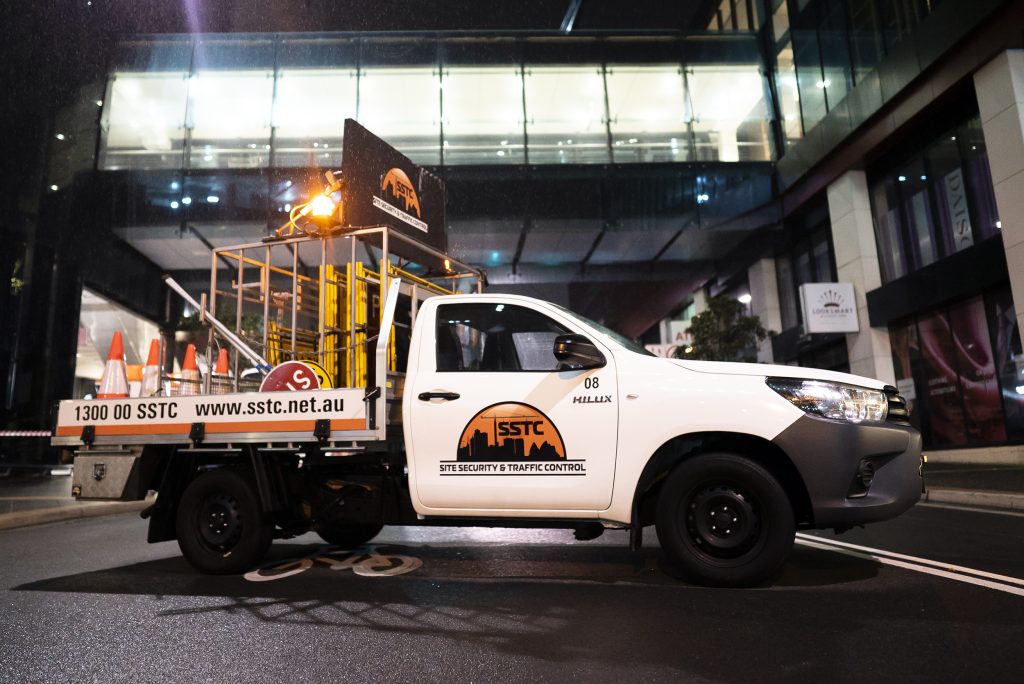
In the high-pressure world of construction, time is money. A rejected CTMP can delay a project start date by months. A shutdown notice from SafeWork NSW due to a non-compliant TCP can cost thousands in idle labour and fines.
Don't leave your compliance to chance. Whether you are at the DA stage and need a strategic CTMP, or you are ready to break ground and need a technical Traffic Guidance Scheme and Road Occupancy Licence, SSTC has the expertise to navigate the bureaucracy for you.
We bridge the gap between the Construction Traffic Control teams on the ground and the planners in the office. This feedback loop ensures that our plans are not just compliant but practical and safe for the people who have to work under them.
Ready to secure your permits and get your project moving?
Explore our professional Traffic Control Services or get a free quote from our team today to discuss your site's specific requirements.